Solar Panel Mounts for Different Roofs: How to Choose the Safest Solution in 2026
Your roof is the most important support for installing a solar power system, and even the most modern system can become a source of problems if its foundations are not chosen correctly. We fully understand your concerns about losing roof watertightness or facing corrosion, because Latvia's unpredictable weather and heavy snow loads require special precision. No one wants to discover, after the first serious winter, roof-covering damage that could have been prevented already at the planning stage.
In this article, we will help you understand which solar panel mounts for different roofs are best suited, so your system remains safe and serves for at least 25 years without unnecessary worries. We promise to bring clarity about material compatibility and show how the standards relevant in 2026 help guarantee long-term roof safety. You will learn about specific installation methods for both tile roofs and metal profile roofs, and you will gain confidence in choosing high-quality mounting solutions that do not threaten the peace of mind of your home or the value of your investment.
Why are solar panel mounts the foundation of the entire system?
Many people begin planning a solar panel installation by thinking only about the panels' capacity or efficiency. However, it is precisely solar panel mounting systems that ensure your investment stays on the roof even after the strongest storm. The mounting system is the load-bearing structure that acts as a secure bridge between the building's roof and the panels. It is not just a collection of metal parts; it is an engineering system that must withstand enormous loads for decades.
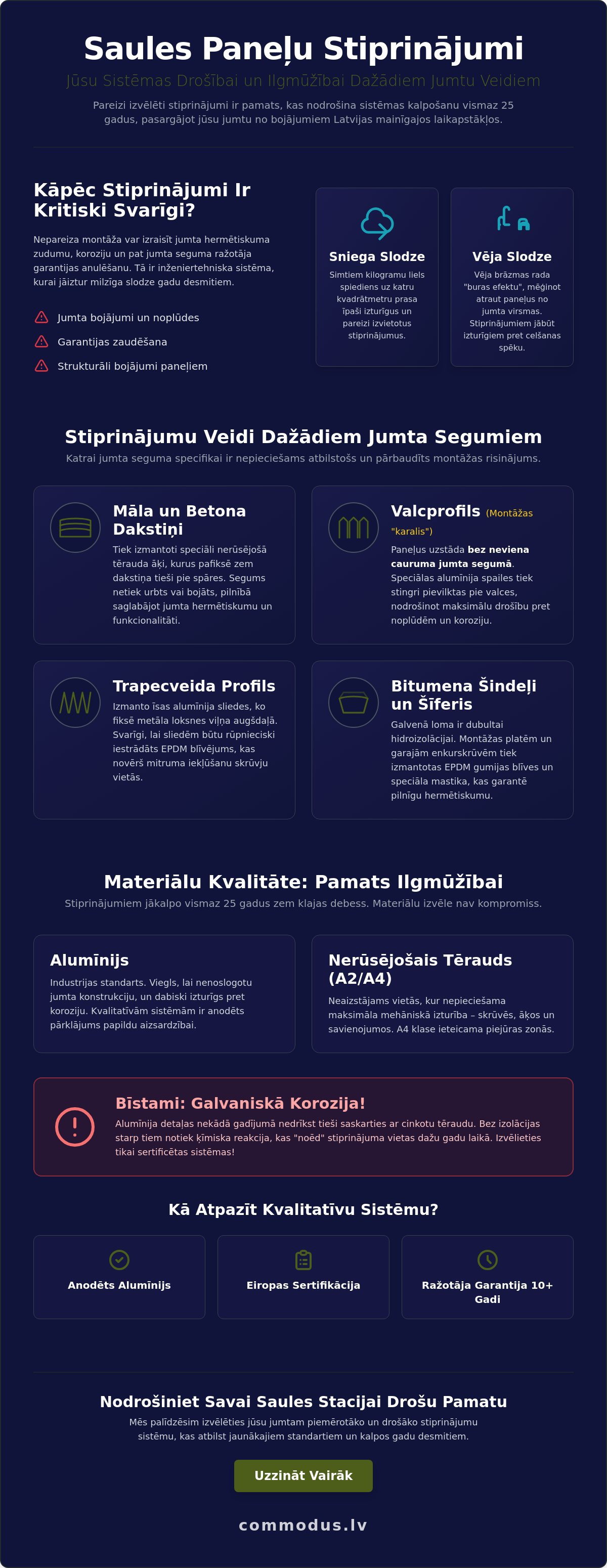
In Latvian conditions, mounting systems face serious tests. In winter, a considerable layer of snow can accumulate on the panels, creating hundreds of kilograms of pressure on every square metre. If the chosen solar panel mounts for different roofs are not properly certified or are incorrectly positioned, there is a risk of damaging both the panels and the roof structure itself. Wind gusts must also be considered, because they create a sail effect under the panels, trying to literally tear them from the surface.
Incorrect installation can become an expensive mistake, because it often voids the roof covering manufacturer's warranty. If a mounting point is installed incorrectly, watertightness is compromised and moisture slowly begins to damage the rafters. In addition, metal heats up and expands in the sun, then cools and contracts at night. High-quality mounts must allow the panels to "breathe" in this way, so thermal expansion does not cause cracks in panel frames or screw connections.
Load calculation: snow and wind in Latvia
In 2026, engineers' work has become even more precise, because the latest data on climate change requires us to account for more extreme weather. With the latest updates to LBN standards in January 2026, designers now use more detailed wind and snow zone maps. The density and positioning of mounts are no longer determined by general assumptions. They now depend directly on building height, roof pitch and even the density of surrounding development. The higher the building and the steeper the roof, the stronger the mounting points must be to prevent any vibration or displacement.
Types of mounts for different roof coverings
When choosing an installation solution, the first rule is to forget universal systems. There is no single "right" model that suits everything. Each covering requires its own approach to preserve your home's peace of mind and roof warranty. Internationally recognised types of mounts range from simple rails to complex anchor systems, and their choice directly affects the system's service life. In Latvia, the most common solar panel mounts for different roofs are classified by their fixing mechanism, ensuring that no screw hole becomes the reason for a leaking ceiling a few years later.
For clay and concrete tile roofs, we use special stainless-steel hooks. They are placed under the tile and fixed directly to the rafter. The covering itself is neither drilled nor cut, preserving its natural water drainage function. For bitumen shingles or roofing felt, mounting plates with double waterproofing are required. Here, each mounting point is additionally sealed with a special mastic or self-adhesive EPDM spacers. For fibre-cement slate, also known as Eternit covering, we use long anchor screws that pass through the wave of the covering and drill into the rafter, while wide rubber washers ensure tightness.
Specifics of installation on metal roofs
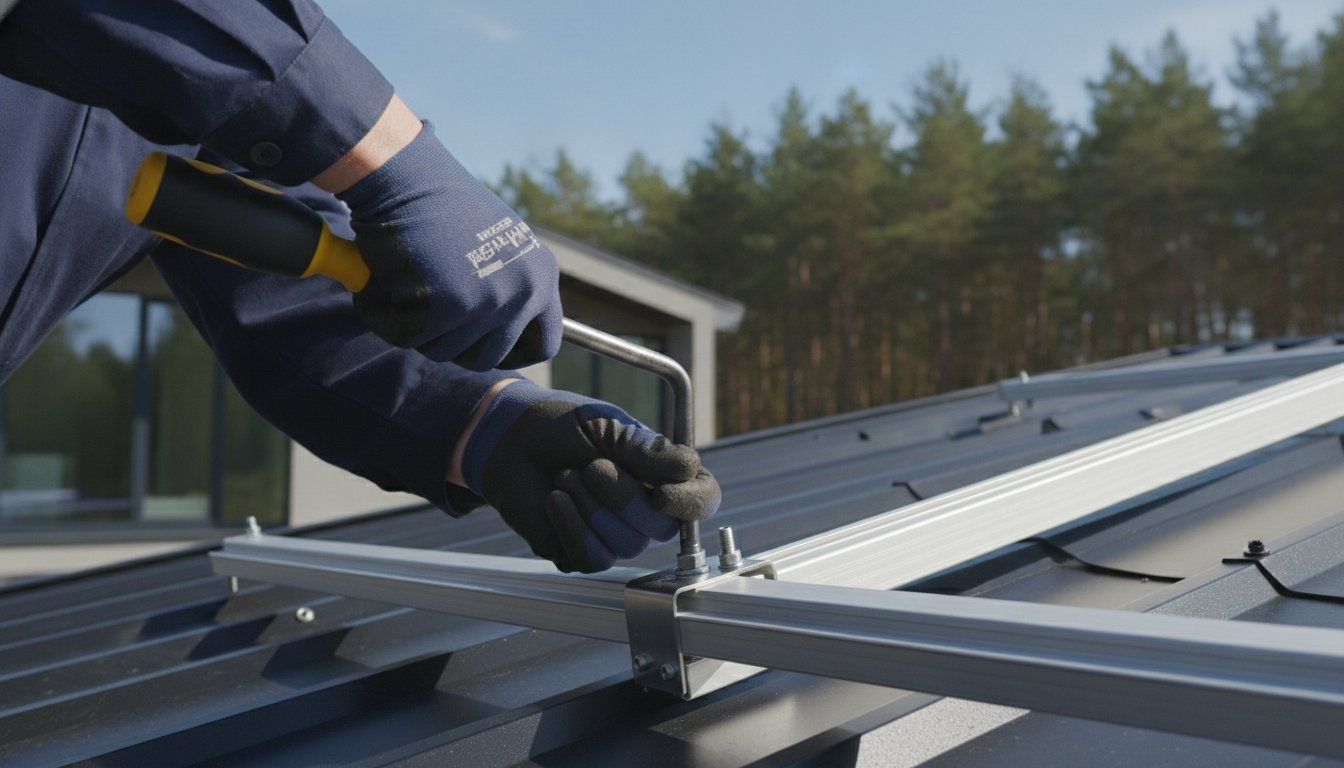
Standing seam roofing is the "king" of installation. Its main advantage is the ability to install panels without a single hole in the roof covering. Special clamps are firmly tightened onto the seam rib, without creating a risk of corrosion or leaks. The approach is different for trapezoidal profile sheets. Here we use short aluminium rails that are fixed directly to the upper part of the metal sheet wave. It is important that these rails already have factory-installed sealing that prevents moisture from reaching the screw points.
Soft and slate roofs: how to preserve watertightness
When working with soft coverings or slate, EPDM rubber seals play the key role. This is a synthetic rubber that does not crack in the sun and does not break in sub-zero temperatures. If the roof structure is weaker, chemical anchor bolts are used. They literally bond the mount to the building's load-bearing structure, creating a monolithic and secure connection. Solar energy systems are often planned together with heating modernisation, where CTC air-to-water heat pumps are very useful for efficient use of the electricity produced, so roof safety must be considered from the very first day.
Material quality: aluminium vs stainless steel
When choosing installation components, it is important to understand that they will remain outdoors for at least a quarter of a century. Aluminium profiles have become the industry standard because they are incredibly light while still resistant to corrosion. This is essential to avoid unnecessary load on the roof structure. However, in places where maximum mechanical strength is required, such as roof hooks and screws, stainless steel is irreplaceable. We usually use A2-grade materials, while in more aggressive environments, such as coastal areas, A4-grade steel is recommended.
One of the most dangerous risks often caused by inexperienced installers is galvanic corrosion. When solar panel mounts for different roofs are installed, aluminium parts must never come into direct contact with galvanised steel. Without special insulation between these metals, a chemical reaction occurs that can literally "eat away" the mounting points within a few years. We choose only certified systems where every connection is engineered and safe, preventing any incompatibility between metals.
How to recognise a high-quality mounting system?
A high-quality system can be recognised by anodised aluminium. This additional protective layer is critical in Latvia's changing weather, where salty air and moisture accelerate oxidation processes. It is important to check the technical data sheets; they should specify not only the material, but also certification according to European standards. If the manufacturer offers a warranty of 10 years or more, it shows confidence in the purity of the materials and their ability to withstand load. High-quality materials are your long-term guarantee of peace of mind.
If you are planning to improve your home's energy efficiency and are looking for a reliable partner, choose professional solar panel kits, where every detail is selected according to the highest quality standards.
Professional installation and Commodus solutions
DIY installation may seem like a good way to save money, but mistakes at this stage can be very expensive and often void the roof covering warranty. One of the most dangerous issues we encounter is an insufficient number of mounting points chosen to reduce material costs. If solar panel mounts for different roofs are not placed densely enough, the whole system loses resistance to strong wind gusts, which are becoming more frequent in 2026 forecasts. Incorrect sealing is just as critical; carelessly applied mastics or unsuitable spacers sooner or later lead to moisture entering the roof structure and damaging the rafters.
The Commodus approach is based on engineering precision and personal responsibility for every project. We never start work without a thorough site inspection, during which we assess the roof's technical condition and load-bearing capacity. An individual mounting design is developed for every customer, calculating precise loads point by point. This ensures that the solar panel kits we offer are integrated with the roof as one unified and watertight whole.
Even after successful installation, it is important not to forget system maintenance. Although we use only the highest-quality anodised aluminium and stainless-steel components, we recommend a preventive inspection every few years. Under the influence of temperature fluctuations and vibrations, screw tightening can change slightly, so professional control guarantees system safety and maximum energy yield for decades.
Why trust the installation to experts?
By entrusting the work to our technicians, you receive a full engineering guarantee for the safety of the entire building structure. We understand the specifics of every roof covering and can anticipate risks that a non-specialist may miss. Commodus provides a full service cycle that begins with design and ends with a completed system that is often combined with solutions such as projects intended for heat pump installation. This integrated approach allows you to feel secure about your home and the value of your investment.
Prepare your roof for energy independence
By choosing solar energy, you are investing not only in technology, but also in your home's stability. Correctly selected solar panel mounts for different roofs are the element that ensures the safety of the entire system and protects the roof covering from unnecessary damage for decades. Remember that only the highest-quality materials and engineering-accurate load calculations can withstand Latvian winters and storms while preserving your home's watertightness and the long-term value of your investment.
The Commodus team, with more than 15 years of experience in installing engineering systems, will help you find the safest solution. Our engineers perform individual calculations for every project, carefully assessing both the roof specifics and the climatic conditions, and we provide professional installation throughout Latvia. We are here to support you and deliver work that will serve reliably and without unnecessary worries.
Contact Commodus experts and receive an accurate calculation for your roof!
Together, we will create a safe and energy-efficient environment in your home, so solar energy brings only joy and genuine independence.
Frequently asked questions about solar panel mounts
Can solar panel mounts damage my roof warranty?
Yes, incorrect installation can void your roof covering manufacturer's warranty if the work is carried out contrary to technical requirements. To avoid this, it is essential to choose certified systems and professional installation that does not affect the integrity of the roof structure. Professionally installed solar panel mounts for different roofs are fixed in a way that preserves the covering's watertightness and the operating rules specified by the manufacturer.
What is the best mounting method for metal roofs so they do not leak?
For standing seam roofs, the safest solution is special clamps fixed to the roof seams without any drilling into the covering. For other metal profiles, special rails with factory-installed EPDM rubber seals are used, tightly closing the screw points. This approach fully prevents the risk of moisture penetration and protects the metal from corrosion forming at the mounting points, ensuring longevity.
Can solar panels be installed on an old slate roof?
Technically it is possible, but we strongly recommend not installing panels on an old and fragile fibre-cement slate covering. Old material can crack easily during installation, and its remaining service life is usually shorter than the panels' 25-year cycle. It is much wiser to combine the solar power system installation with replacing the roof covering, avoiding costly system dismantling after a few years.
How many mounts are needed for one solar panel?
As standard, one panel needs four fixing points, but the exact number is determined by engineering calculations for each specific project. In Latvia's climate, where significant snow and wind loads must be considered, the density of mounts may be increased depending on roof pitch and building height. This guarantees that the selected solar panel mounts for different roofs will withstand even extreme weather without structural deformation.
Do mounts need to be replaced together with solar panels?
No, if high-quality anodised aluminium and stainless-steel materials are chosen from the start, they usually last longer than the panels themselves. Mounting systems are designed for 30 or more years of operation, so when modernising panels, a visual inspection and screw tightening check are usually sufficient. It is important not to choose cheap alternatives at the beginning, as they may start rusting much earlier than promised.
Comments