Solar Panel Payback Period in 2026: What Does It Depend On in Latvia?
Did you know that in 2026 the payback period for solar panels no longer depends only on how much one kilowatt-hour costs on the exchange? It has become a question of how skillfully you can align your daily rhythm with the solar cycle and the new market rules. We fully understand that the new net settlement system and changes in state support programs can create real confusion. It is easy to get lost in complex calculations when virtual wallets and changing grid capacity fees are involved, especially now that they came fully into force at the beginning of this year.
Find out how many years it really takes for an investment in solar panels to pay for itself, taking into account current 2026 trends and the EKII support for households that is still available. In this article, we will not only look at the path to the "zero" point, but also share practical advice on how smart self-consumption and battery systems can significantly shorten this period. Our team is here to help you make a balanced decision, so your home can become a secure and independent energy island for the long term, where every ray of sunshine works directly for you.
What determines the payback period for solar panels in Latvia?
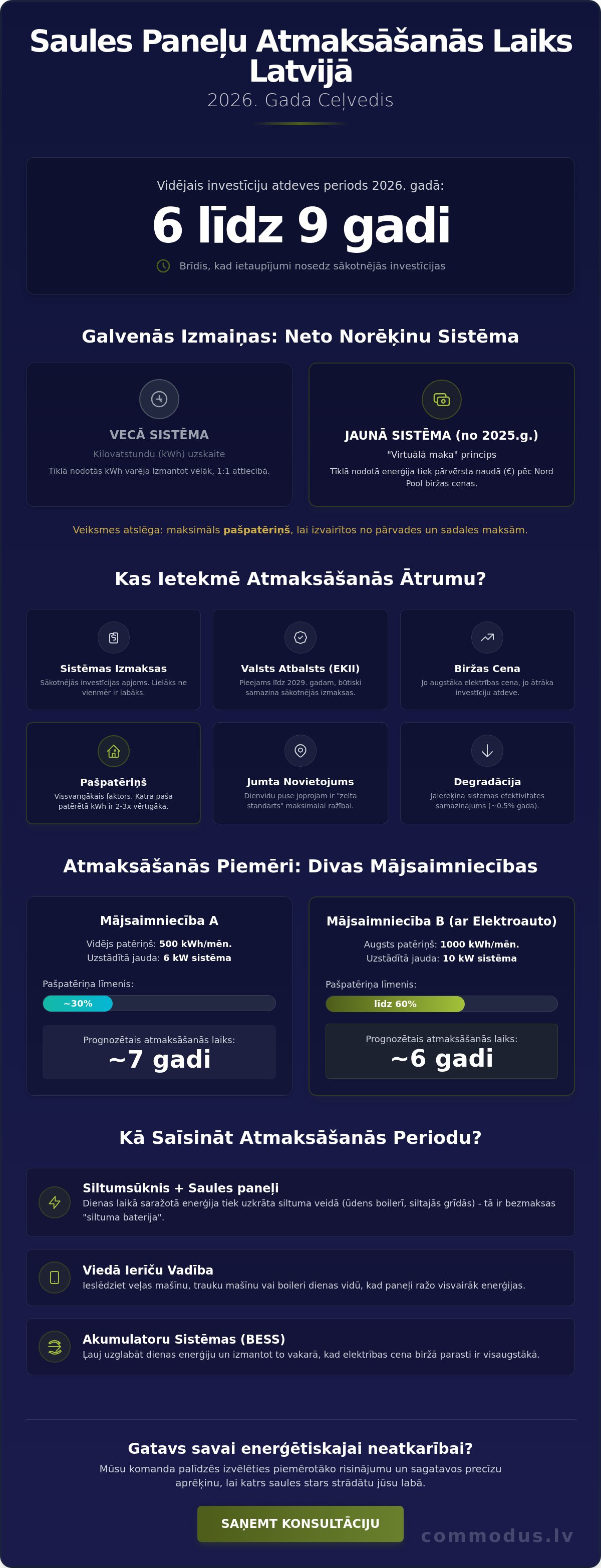
Simply put, the payback period for solar panels is the point at which savings on your electricity bills fully cover the initial investment in purchasing and installing the system. In 2026, this period for Latvian households averages from 6 to 9 years. Of course, every project is unique; for one home it may be a five-year plan, while for another it may take a little longer, depending on consumption habits and the selected equipment.
The net settlement system in force since May 2025 has significantly changed how we look at return on investment. Unlike the old system, where kilowatt-hours were counted, the new arrangement works on the principle of a "virtual wallet". The energy you produce and feed into the grid is converted into monetary value according to the current Nord Pool exchange price. This means that the solar panel payback period is now directly linked to how well you can use electricity at the exact moment when the sun is strongest.
State support remains a strong driver. While the Altum program no longer accepts new applications, EKII (Emission Allowance Auctioning Instrument) support will be available until the end of 2029. It can cover a significant share of costs, substantially reducing the number of years to the "zero" point. Interestingly, when assessing an investment, experts also often mention the energy payback time. This describes the period in which panels generate as much energy as was used in their manufacturing process, and for modern technologies it is only a few years.
Key factors: From roof pitch to exchange price
The south-facing side is still the "gold standard". However, even an ideal location will not help if electricity price forecasts are ignored. In 2026, the market has stabilized, but exchange price fluctuations remain. The higher the electricity price at the moment when you produce power yourself instead of buying it from the grid, the faster your investment payback period shrinks.
Investment size vs system capacity
Bigger is not always better. If you install an overly powerful system that you cannot use for self-consumption, the payback period may slow down. We recommend choosing solar panel kits that precisely match your home's energy efficiency goals. A high-quality inverter and efficient panels will ensure that the system serves for 25 years or more, continuing to produce clean energy long after it has paid for itself.
Calculating return on investment: Real examples
To better understand how the solar panel payback period is formed, let us look at two different scenarios. The first example is an average household with monthly consumption of 500 kWh. By installing an optimal 6 kW system, most of the energy can be consumed immediately, especially if the home has an air conditioner or an electric boiler. In this model, the investment usually pays for itself in about 7 years, because the amount of energy purchased from the grid is significantly reduced.
The second example is more energy-intensive: a house with consumption of 1000 kWh where an electric car is charged. Here, the solar panel payback period can fall to as little as 6 years. Why? Charging the electric car during sunny hours allows self-consumption to increase from the usual 30% to as much as 60%. The less energy you feed into the grid at the exchange price and the more you use yourself, the faster the system pays for itself. It is important to remember that incorrectly selected, excessive capacity will only extend this process, because surplus energy in the virtual wallet accumulates more slowly than real savings.
A calculation formula for your own planning
You can make a preliminary calculation yourself using a simple formula: (Total installation costs - State support) / Forecast annual savings. When planning for the long term, it is essential to include system efficiency degradation, which averages 0.5% per year. For an accurate calculation, it is worth reviewing the current state support programs, which in 2026 still offer a substantial boost for new projects.
Specifics of the net settlement system in 2026
Since the beginning of 2026, households no longer receive state subsidies for distribution tariffs, so self-produced electricity has become even more valuable. The virtual wallet lets you accumulate funds for power fed into the grid, but immediate consumption is still 2-3 times more beneficial. This is because self-consumed energy does not require payment for transmission and distribution. If you want a precisely tailored solution for your roof, our specialists will help you choose the most suitable solar panel kits to maximize your benefit.
Strategies for shortening the payback period
Many people think that installing solar panels is the destination, but in reality it is only the beginning of smart energy management. To reduce the solar panel payback period by several years, the main task is to maximize self-consumption. One of the most effective ways to achieve this is to combine solar energy with modern heating systems. State support for solar panels in Latvia is still available, making the initial investment easier and the return much faster.
A heat pump as a solar energy "battery"
A modern air-to-water heat pump is an excellent ally for solar panels. During the day, when the sun produces the most, the heat pump can heat water in the boiler or underfloor heating, effectively storing energy as heat. It is a free "battery" that does not require additional investment in accumulators, because you use your self-generated electricity exactly when it is produced instead of sending it to the grid at a lower price.
In 2026, battery (BESS) systems are becoming increasingly popular. Although they increase initial costs, they allow solar energy to be used in the evenings, when exchange prices are usually at their highest. Smart control of electrical appliances is just as important. By setting the washing machine or dishwasher to run at midday, you do not send energy to the grid; you use it at full value. Do not forget hygiene: regular panel cleaning from dust or dirt caused by birds can increase efficiency by 5 to 10 percent.
Smart control and energy efficiency
We believe that every house is a unique ecosystem. Commodus solutions help automate these processes so you do not have to monitor the weather forecast every day. The system itself understands when it is most beneficial to switch on the most powerful appliances. If you are planning to improve your home's energy efficiency, explore our offered solar panel kits and consult our knowledgeable technicians about the best integration. Want an accurate calculation for your home? Contact us, and we will help create a system in which solar panels work in tandem with your heating equipment.
Why choose Commodus for solar panel installation?
When choosing a partner for a solar energy project, it is important to remember that the solar panel payback period is not just a theoretical number on paper. It is the result of precise engineering work and correctly selected components that will serve for decades. The Commodus team provides a full service cycle, from a detailed energy audit to system installation and regular maintenance. We are not only installers; we are your guide on the path to energy freedom, providing support at every stage.
Our specialists know the nuances of Latvia's climate very well. We know which fasteners will withstand strong autumn winds and which panels will deliver maximum capacity even in our changeable weather. We actively help prepare all the necessary documentation so you can apply for state support without unnecessary stress. Our local technical support is available throughout Latvia, creating peace of mind and a sense of security that help will remain within easy reach in the long term.
Our approach: Honest calculations without empty promises
We believe in transparency and honest cooperation. That is why our forecast solar panel payback period is based on real data and objective calculations, not overly optimistic assumptions. We do not just sell equipment; we design an individual energy independence plan for each property. We assess the roof structure, surrounding shading, and your family's consumption habits so the system is not the largest possible, but the most effective for your needs.
Start your path to lower bills today
Do not wait for the next jump in electricity prices or tariff changes. Apply for a consultation with our knowledgeable technicians, who will help prepare an accurate payback forecast for your home. Learn more about our offered solar panel kits and take the first step toward smart and green home management. We will be with you at every stage, ensuring quality and human responsiveness, which form the foundation of our team's work.
Start producing your own energy smartly and with foresight
Installing solar panels in 2026 is a forward-looking step toward home independence and financial stability. As we have seen, the solar panel payback period no longer depends only on the length of sunshine. It is about your ability to manage the generated power wisely, use available state support, and integrate modern heating systems. By combining panels with a heat pump, you not only reduce monthly expenses but also increase your property's long-term value.
Our team has more than 14 years of experience in creating engineering systems, and hundreds of completed projects throughout Latvia confirm our competence. Certified installation specialists will make sure every connection is safe and every calculation is precise. We believe that every client is a partner who deserves honest treatment and high-quality execution, regardless of project scale.
Apply for a free solar panel payback calculation
Start your path to greener and cheaper energy together with a reliable team of technicians. We are ready to help you turn sunlight into real savings and peace of mind today.
Frequently asked questions about solar panel returns
How many years does it take solar panels to pay for themselves in Latvia on average?
On average, the solar panel payback period in Latvia in 2026 is from 6 to 9 years. This period directly depends on how much of the generated energy you consume immediately and how much state support you use to purchase the system. A high-quality and correctly designed system continues to generate profit for at least another 20 years after the initial investment has fully paid for itself.
Is state support still available for solar panel installation?
Yes, EKII, or the Emission Allowance Auctioning Instrument, support is available until December 31, 2029. This program allows households to receive significant co-financing for installing a new system, which substantially reduces initial expenses. It is one of the main factors that makes it possible to achieve an optimal solar panel payback period under current market conditions.
How does the net settlement system affect the payback period?
The net settlement system works on the principle of a virtual wallet, where energy fed into the grid is converted into euros according to current exchange prices. The payback period becomes shorter if you can use as much electricity as possible exactly at the moment of production. Since a distribution tariff must be paid for energy fed into the grid and later received back, immediate self-consumption is the most financially beneficial solution.
Do solar panels pay off if I have a heat pump?
The combination of a heat pump and solar panels is one of the best ways to accelerate return on investment. A heat pump can consume a significant share of the generated energy for heating water or cooling rooms directly during sunny hours. This synergy makes it possible to significantly increase the self-consumption percentage, helping the system pay for itself several years faster than in a standard household.
Is it worth installing solar panels on the north side of a house?
Installing panels on a north-facing slope is usually not financially justified, because production efficiency there is too low. The best results and fastest return come from the south side, as well as east- or west-facing slopes, which allow energy to be produced in the morning and evening hours. If the north side of your roof is the only free space, we usually recommend considering panel placement on ground-mounted structures.
Comments