State Support for Solar Panels for Private Homes 2026: A Complete Guide to Getting Funding

Did you know that since 2022, more than 15,700 Latvian households have already used state co-financing to become more energy independent? We understand that the path to solar energy often feels strewn with bureaucratic hurdles, complicated paperwork, and uncertainty about whether your property even qualifies for support. It's completely normal to feel a little overwhelmed by the various programmes and technical requirements, which are regularly updated - that's why our team is here to bring you clarity.
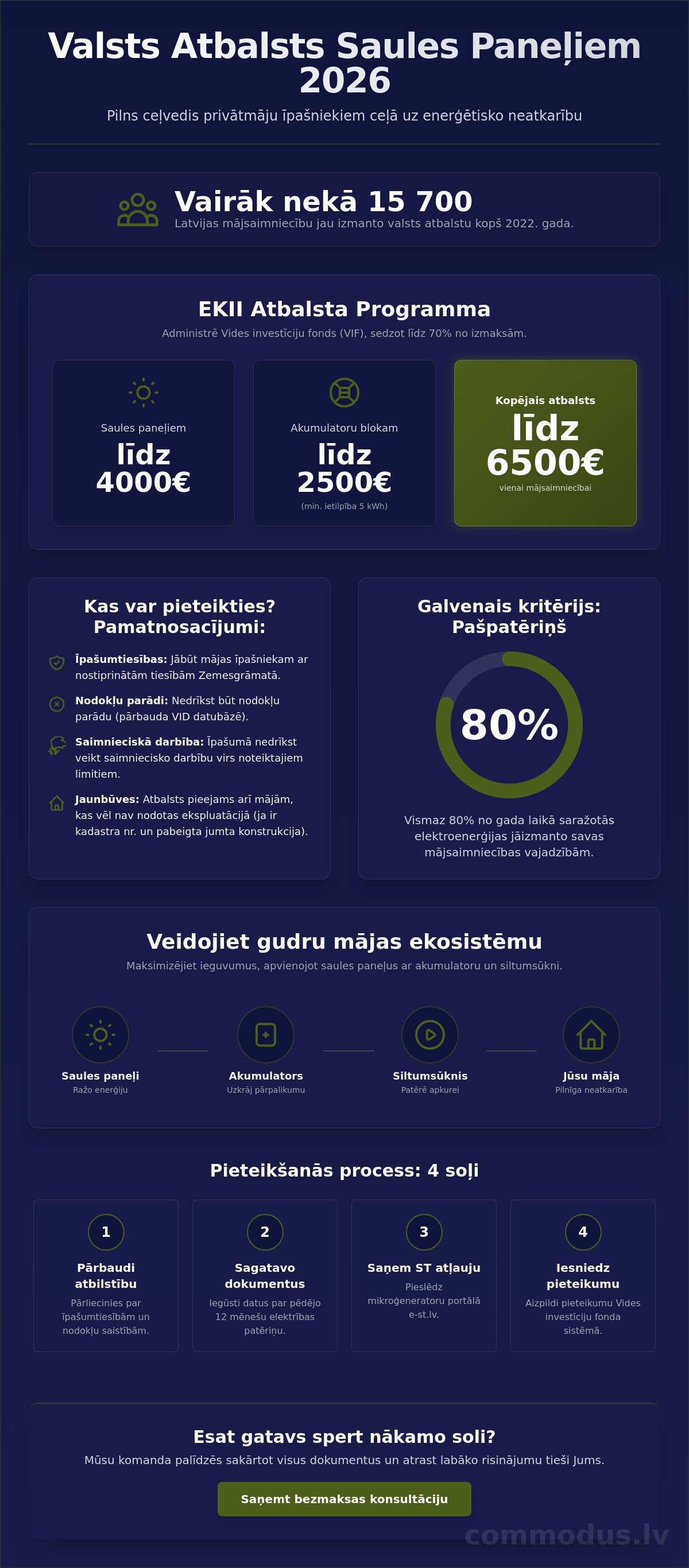
In this article, we'll help you navigate the current situation so that state support for solar panels for private homes in 2026 becomes a clear and achievable goal. You'll learn everything about the EKII programme, which lets you receive support of up to €6,500 for installing panels and battery storage, and you'll find out what new opportunities are planned for "Latvia's Families of Honour". We'll guide you through the entire process, from meeting the 80% self-consumption requirement to successfully submitting your application, giving you a practical action plan for your peace of mind and energy freedom.
Current state support programmes for solar panels in 2026
2026 is a significant year for every private homeowner who wants to reduce their dependence on volatile electricity prices. The main driving force right now is the Emission Allowance Auction Instrument (EKII) programme, administered by the Environmental Investment Fund (VIF). This programme is not just a technical document - it's a real financial tool that covers up to 70% of equipment purchase and installation costs. The current energy policy in Latvia clearly signals a desire to promote household self-sufficiency, which is why state support for solar panels for private homes in 2026 has become more accessible and easier to understand.
Funding under the VIF programme is limited, and although the application deadline is set for the end of 2029, funds are reserved on a first-come, first-served basis. Experience shows that 2026 specifically is a crucial year, as technology prices have stabilised while the level of state support remains high. This is an ideal moment to combine solar energy with other modern systems, such as installing air-to-water heat pumps, which together create a smart and economical home ecosystem.
Specifics of the Environmental Investment Fund (VIF) programme
The maximum support per household can reach up to €6,500 if the project combines solar panels with battery storage systems. For installing the solar power plant itself, you can receive co-financing of up to €4,000. A key requirement is the 80% self-consumption rule, which means the system must be designed according to your actual consumption rather than the maximum possible output. The application will require a permit from "Sadales tīkls" and data on your electricity consumption for the past 12 months, so it's advisable to start preparing the documents early.
Battery storage units: a new priority in state support
While batteries used to be seen as an expensive add-on, in 2026 they have become a priority. The state offers support of up to €2,500 specifically for purchasing battery storage units (BESS). To qualify for this funding, the equipment must have a minimum capacity of at least 5 kWh. This step has been taken to encourage residents to use the energy they generate on-site rather than putting extra strain on the shared grid. Installing batteries lets you make the most of energy generated during the day in the evenings, when consumption is usually highest, ensuring genuine energy independence.
Who can apply, and what are the main requirements?
For the application process to go smoothly, the first step is to confirm your property's legal status. You must be the owner of the home, and this right must be registered in the Land Register. This is the foundation that ensures state support for solar panels for private homes in 2026 reaches you directly. We often see clients worry about small details, but what matters most is well-organised documentation and a clear picture of your energy consumption.
One of the most important criteria is the 80% self-consumption rule. This means at least four-fifths of the electricity generated over the year must be used for your household's needs. This requirement guards against installing oversized and inefficient systems. It's also worth noting that the property must not be used for registered business activity exceeding the limits set out in the support programme. Before submitting your application, be sure to check that you have no outstanding tax debts, since even a small overdue amount in the SRS database can be grounds for rejection. According to the guidelines of the official government support programme, the conditions for receiving support have become clearer, although precision is still a priority.
Technical requirements and Sadales tīkls permits
Obtaining a permit to connect a micro-generator via the e-st.lv portal is a step you can't skip. You'll need documented proof of your electricity consumption over the past 12 months. This serves as evidence that the chosen panel capacity is proportionate to your actual needs. If you're planning to improve your energy efficiency even further, it's worth considering how a modern CTC air-to-water heat pump would fit into the system, helping you reach the required self-consumption level.
Putting your home into operation and its effect on support
Many homeowners ask whether support is also available for new builds. The answer is yes. Even if the house hasn't been fully put into operation yet, but is registered as a new building with its own cadastral number, you can still apply for funding. The main requirement is that the roof or structural work is complete, allowing the panels to be securely mounted and connected to the grid. This approach lets you plan for energy independence right from the construction stage of your home.
Why is 2026 the right time to integrate batteries and heat pumps?
Solar panels on their own are a great start, but in 2026 we're seeing a clear trend of households moving towards full-fledged energy ecosystems. Panels without a heat pump or battery are often only halfway to true independence. That's why state support for solar panels for private homes in 2026 is particularly advantageous for those planning to integrate several systems at once. The Environmental Investment Fund's support programme is currently actively promoting exactly this kind of integrated approach, allowing you to maximise the level of support.
The shift to a net metering system has fundamentally changed the rules of the game. Now, every kilowatt-hour you consume yourself is worth far more than the energy you feed back into the grid. That makes a heat pump the ideal partner for solar panels, since it can efficiently use the generated power for heating and hot water exactly when the sun is shining brightest. To better understand this technical side, we recommend reading our air-to-water heat pump guide, which explains in detail the synergy between these technologies.
Synergy between heat pumps and solar panels
A properly planned system allows solar energy to cover as much as 70% of a heat pump's annual electricity consumption. That's a huge step towards zero-euro heating bills. Our experience shows that air-to-water heat pumps in particular deliver the highest efficiency when combined with solar panels, since their smart controls automatically adapt to the energy generation cycles. This isn't just a technical solution - it's a long-term investment in your comfort and your home's rising value.
Smart energy management
To receive the maximum state support, using smart inverters is becoming increasingly important. They ensure that the generated energy is directed where it's needed most - whether that's the battery, the heat pump, or your home's ventilation and heat recovery system. This kind of smart management ensures that not a single ray of sunshine is wasted. If you'd like to accurately calculate your home's potential and design an optimal system, we invite you to book a consultation with our specialists, who will help you take the next step towards energy freedom.
Professional support from project design to receiving funding
We know that bureaucracy and the fear of making mistakes in paperwork are the biggest obstacles on the path to solar energy. The Commodus team has been working in this industry since 2010. Over the years, we've become convinced that it's not enough just to install quality equipment - we also need to ensure that state support for solar panels for private homes in 2026 reaches your account without delays. We're not just salespeople. We're engineers and practitioners who care about your home's energy efficiency and your long-term peace of mind.
Unlike vague promises to "sort out the paperwork", we offer a full service cycle. It starts with a real on-site survey and only ends once the Environmental Investment Fund has approved your application. Our specialists help you avoid critical errors in capacity calculations or technical documentation, which are often the reason for rejection. We provide warranty coverage and prompt technical support throughout Latvia, creating a safe and reassuring atmosphere at every stage of our cooperation.
Why choose Commodus for your project?
We believe every home is unique, which is why our approach is based on precise measurements. It's essential that the chosen solar panel kits perform at their best for your specific conditions. We don't recommend the largest system - we recommend the one that best matches your consumption habits and helps you meet the state support requirements without unnecessary expense.
Step by step: your path to receiving support with us
Our team is your equal partner throughout the process. We are active doers who aren't afraid of challenges or complex technical solutions. The path with us is clear and transparent:
- Free consultation: We assess the potential and energy efficiency of your property.
- Technical design: We develop the design and coordinate it with "Sadales tīkls" on your behalf.
- Installation and reporting: We carry out professional installation and prepare all the reports needed to receive funding.
If you want a reliable result and a professional approach, contact our experts today. We'll help you take the final step towards energy independence, answering all your questions before you even ask them.
Take the next step towards energy freedom today
2026 marks a new era for energy efficiency in Latvian households, where solar panels are no longer just a standalone component, but part of a smart, integrated home system. The key takeaway is clear: by combining panels with battery storage units and heat pumps, you not only maximise self-consumption, but also secure the highest possible level of co-financing for yourself. Remember that state support for solar panels for private homes in 2026 is available on a first-come, first-served basis, so preparing your documents early and getting accurate engineering calculations are crucial for your project's success. It's not worth putting off the decision until the last minute while programme funding is still available.
Our team, with more than 15 years of experience in the market and over 5,000 projects completed across Latvia, is ready to become your trusted partner. We provide full-service engineering support so that you can completely forget about the burden of paperwork and focus on the savings ahead. No matter how complicated the documentation or technical requirements seem, we're here to help you at every stage, from the very first site survey to the final signature on the report. Our priority is your peace of mind and an energy-efficient home for many years to come.
Book a free consultation and find out your options for receiving state support!
Your journey to true energy independence begins with one well-considered decision, and we'd be truly delighted to help you achieve it according to the best industry standards.
Frequently asked questions about state support
What is the maximum amount of state support available in 2026?
Under the EKII programme, the maximum support per household can reach up to €6,500. This amount is made up of up to €4,000 for installing a solar panel system and up to €2,500 for a battery storage unit with a capacity of at least 5 kWh. It's important to know that state support for solar panels for private homes in 2026 covers up to 70% of eligible costs, which significantly reduces the size of your initial investment.
Can I receive support if I install the solar panels myself?
No, installing the equipment yourself rules out the possibility of receiving state funding. The programme's conditions strictly require that both the purchase and installation of the equipment be carried out by a certified contractor who can vouch for the quality of the work. This guarantees that the system will operate safely and meet all the engineering requirements set by the Environmental Investment Fund when reviewing your application.
How long after submitting documents is the support paid out?
Support is usually paid out within approximately 20 working days after the Environmental Investment Fund has reviewed all the submitted documents and signed the agreement. The process has become faster and more transparent, but it's essential that all invoices and acceptance certificates are filled out without errors. Our team helps prepare these documents to avoid any delays due to inaccuracies.
Does state support also apply to solar collectors for heating water?
Yes, the EKII programme also provides support for installing solar collectors intended for generating heat energy and heating water. This solution is an excellent addition to your home's energy efficiency, especially if your household has high hot water consumption. State support for solar panels for private homes in 2026 is flexible and allows you to combine different technologies to achieve maximum energy independence.
What happens if I don't reach the 80% self-consumption rate?
The 80% self-consumption rate is a requirement checked at the system planning stage, based on your electricity consumption data from the past 12 months. This is necessary to get your application approved and to prevent the installation of oversized systems. If actual consumption fluctuates slightly after installation, this usually doesn't result in immediate penalties, but the system's capacity must be chosen responsibly so that it's proportionate to your real needs.
Comments