Solar Panels with Battery Prices: Complete Guide and Cost Analysis in 2026
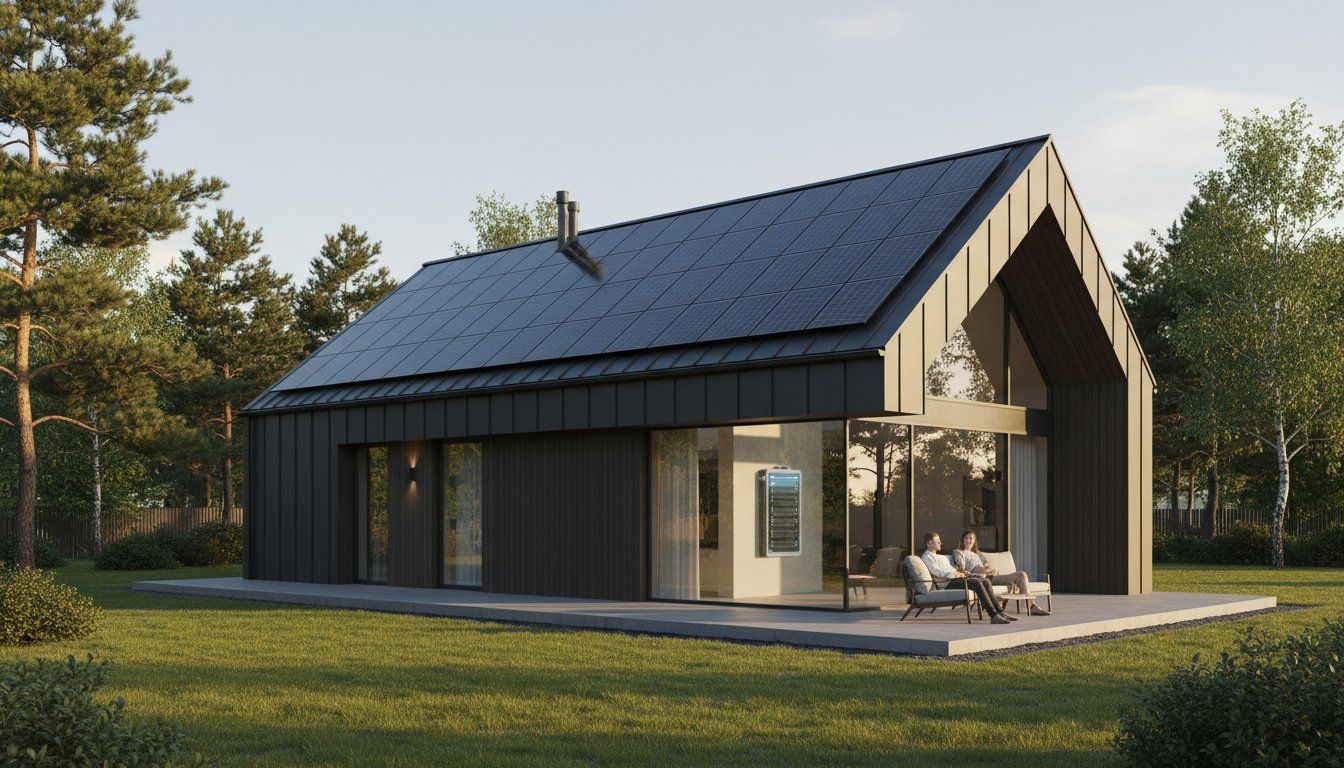
Selling the electricity you generate back to the public grid is no longer the most profitable path to energy independence. With changes in the NETO settlement system, solar panels with battery prices and their payback period have become the main topic of discussion in every household planning a transition to green energy. In 2026, a battery is no longer a luxury item, but a smart tool that lets you use your own energy exactly when you need it most, instead of giving it away to others at a low price.
We understand that navigating technical parameters and calculating a system's real usefulness can be challenging, especially when there is concern about choosing the wrong capacity. In this guide, we will clearly and simply analyze how costs are formed and which state support programs, such as Environmental Investment Fund grants of up to 50% for battery purchases, are available right now. You will get a complete picture of price categories and learn how to choose technology that will serve you for many years, providing peace of mind and real savings. In the rest of the article, we will review current market data, the steps for receiving support, and practical advice for system planning.
Solar panels with battery prices: what do they depend on?
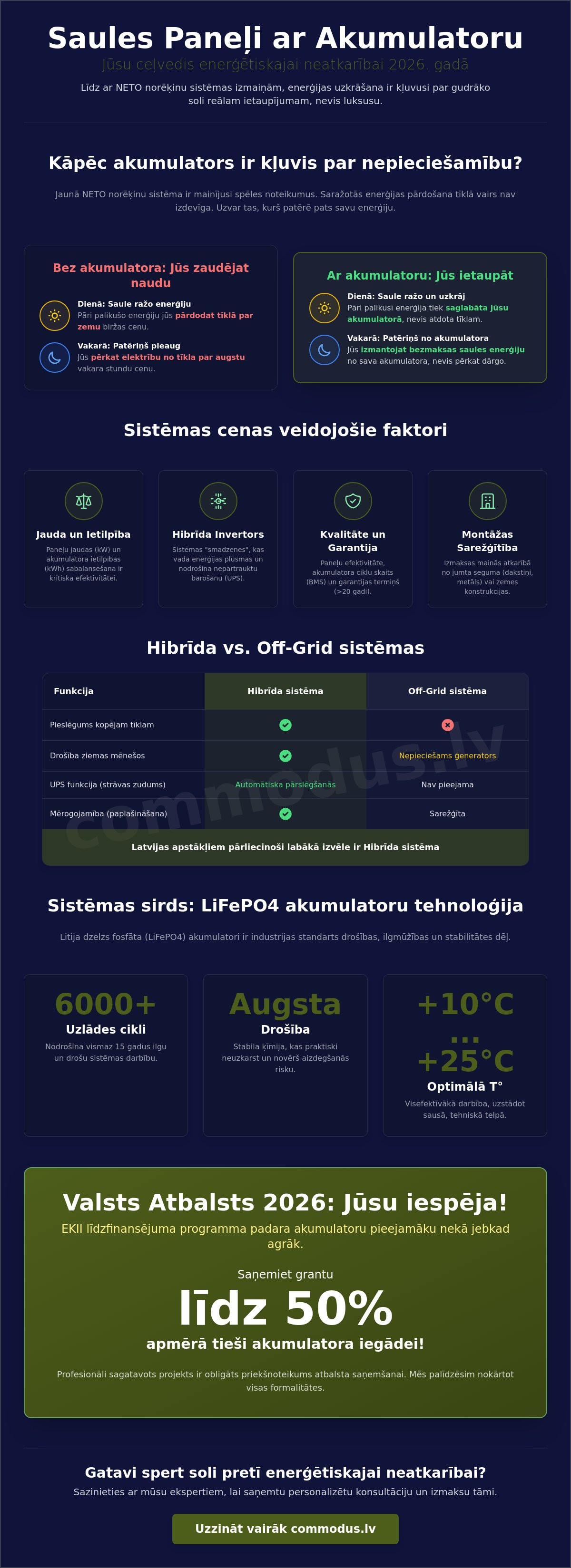
When planning an investment in your own energy, the first question is usually the total cost. However, solar panels with battery prices are not a fixed number determined only by the number of panels. They are the result of several technical and engineering decisions, where every detail plays a role in the final estimate. The right balance lies in the proportion between system power (kW) and battery capacity (kWh). If you install too few panels, the battery will never be fully charged on cloudy days. On the other hand, an oversized battery without matching solar capacity will be an expensive investment that is not used efficiently enough.
The hybrid inverter has enormous importance. It is the brain of the entire system, coordinating energy flow between the panels, battery, home network, and public electricity grid. When choosing between Hybrid vs. Off-grid systems, it is important to understand that a hybrid inverter provides uninterrupted power even when voltage disappears from the grid. This is an essential comfort factor, and it is also reflected in the cost. Installation complexity can also significantly change the number shown in the estimate. Installation on a tile roof requires more time and specific fasteners than work on metal roofing or ground-mounted structures.
Components that shape the final estimate
Panel efficiency directly affects how much roof space they will occupy. Higher-class panels have a longer warranty period, often exceeding 20 years, which provides long-term security. The battery management system, or BMS, is no less important. It takes care of safety by preventing overheating and monitoring the charge level of each cell. When choosing the cheapest battery, you need to expect a smaller number of charge cycles. This means that after a few years the system may lose a large part of its capacity, turning the initial saving into a loss.
Design and engineering service costs
Many people forget that a professionally developed project is not just a formality. It is a mandatory prerequisite for applying for state support and receiving permits from AS "Sadales tīkls". High-quality design ensures that the system is coordinated with other home engineering systems, such as an air-to-water heat pump or a heat recovery ventilation system. This helps create a unified and energy-efficient hub where solar energy is smartly directed to heating or water heating exactly when the battery is full.
Hybrid vs. Off-grid systems: which should you choose for your home?
Choosing between a hybrid and an off-grid system is a fundamental decision that affects not only everyday comfort, but also how quickly solar panels with battery prices pay back. In Latvian conditions, where there is significantly less sunlight in the winter months, the hybrid system has become the clear favorite. It combines the best of both worlds. You have a safety net from the public grid and a battery that covers consumption during expensive evening peak hours, when the sun has already set.
Fully autonomous, or off-grid, systems are suitable for places where a grid connection is impossible or disproportionately expensive. However, you need to account for the fact that in December and January sunlight alone will not be enough and an additional generator will be needed. Hybrid solar panel kits remove this risk by automatically switching between sources. This is especially important if sensitive electronics or a heat pump operate in the home. When planning this kind of investment, it is worth using state support programs in 2026, which significantly reduce the initial expense.
Technical comparison and efficiency
Modern hybrid inverters offer a UPS, or uninterruptible power supply, function. In the event of a power outage, the system switches to the battery within milliseconds. You will not even notice it, because computers and smart home systems will continue working without restarting. Another advantage is scalability. If at first solar panels with battery prices seem too heavy a burden, you can start with a smaller capacity and add extra modules later, when energy demand increases.
Battery technologies: LiFePO4 vs. alternatives
Lithium iron phosphate (LiFePO4) batteries are currently the industry standard because of their safety and long service life. Unlike older technologies, they practically do not overheat and can last for up to 6000 charge cycles. That means at least 15 years of reliable operation. Placement is important to remember. Although these batteries are durable, they feel best at temperatures from +10 to +25 degrees. We therefore recommend installing them in technical rooms, not in unheated sheds. If you want to choose the most suitable capacity for your home, view our solar panel solutions and receive professional advice from our specialists.
Investment payback and state support programs in 2026
The transition from the previous net metering system to the new net billing model has significantly changed how we evaluate energy investments. The main goal is no longer to feed as much electricity as possible into the grid, but to use it for self-consumption as much as possible. This is exactly where the true value of batteries appears. Without them, you sell solar energy at the exchange price, which is often low in the middle of the day, and then buy it back in the evening at a higher price. A battery eliminates this difference by storing your generated power for the moment when it is truly needed.
The good news is that solar panels with battery prices have become more accessible thanks to the state's practical support. As current state support programs in 2026 show, residents can receive EKII co-financing of up to 50% specifically for energy storage solutions. For an average Latvian household, this means the system's payback period is reduced by several years. The efficiency becomes even more pronounced if an air-to-water heat pump is installed in the home. This combination allows solar energy to be converted directly into heat by heating water or rooms, thereby reducing monthly bills even further.
Criteria for receiving state support
To receive the promised funding, the process must begin with properly arranged paperwork. An engineering project and permission from AS "Sadales tīkls" for connecting a microgenerator are required. It is important that the chosen equipment is certified and installed by qualified specialists. Our team will help you prepare all the necessary documentation so that the application process with the Environmental Investment Fund is simple and free of unnecessary stress.
Improving energy efficiency over the long term
An investment in solar technology is a long-term project where service quality is just as important as the equipment itself. Regular maintenance and system monitoring ensure that panels and batteries operate at maximum output throughout their service life. Considering forecasts for electricity price fluctuations in the future, creating your own independent energy hub is the safest way to protect the family budget. If you are planning your path toward energy freedom, view our solar panel kits and choose the solution that best matches your home's needs.
Why choose Commodus for solar system design and installation?
When you choose Commodus, you are not simply buying a set of technical units. You gain confidence that the system will work exactly as planned. Our experience shows that an engineering approach is decisive. When solar panels with battery prices are analyzed, the cheapest offer often does not include full integration with the home's existing infrastructure. We look at the home as one unified organism. This means that solar panels are coordinated with the heating hub and, for example, a modern heat recovery ventilation system, so every watt generated is used as efficiently as possible.
Our team provides a full cycle. We start with an individual consultation and finish with system commissioning and real support afterward. We are right here in Latvia. Our specialists and service teams are available throughout the country. This provides peace of mind that, in any situation, a knowledgeable technician who understands your project down to the last screw will be available. Warranty and post-warranty maintenance with us are not just words on paper, but real action and responsibility toward the client.
Our work process and quality standards
We do not rely on guesses. Before signing a contract, we inspect the site and perform precise power calculations. We use only certified equipment tested for Latvian climate conditions. This guarantees that the system will be efficient both on hot July afternoons and in changeable spring weather. Every installation stage is strictly monitored to ensure system longevity and safety.
An individual approach to every project
Every client is an equal partner to us. The team's personal involvement and support are felt throughout the process, helping you navigate technical details without unnecessary stress. We believe the best solution is born in conversation. That is why we invite you to apply for a free consultation so we can create an individual offer together. View our solar panel solutions and receive a calculation tailored specifically to your home today.
Your step toward a smart and independent future
The energy world in Latvia is changing quickly. Battery systems are no longer just a future vision, but a practical and financially sound solution in today's net billing system. When evaluating solar panels with battery prices, it becomes clear that correctly chosen technology and the use of state support allow the investment to pay back significantly faster than before. The key is to remember that a battery is a tool that works for you precisely during the hours when electricity is most expensive on the market.
The Commodus team, with more than 15 years of experience in energy-efficient solutions, is ready to help you at every stage. Our certified installation specialists provide full service, from the development of a precise engineering project to assistance in receiving support from state funds. We believe every home is unique, so our solutions are always adapted to your specific needs, integrating solar power with the home's heating and ventilation systems.
Contact the Commodus experts and receive an accurate solar system estimate! Together, we will create a solution that gives you peace of mind and long-term financial stability. We look forward to meeting you in your new, energy-efficient home!
Frequently asked questions about solar panels and batteries
Are solar panels with a battery economically worthwhile in Latvia?
Yes, solar panels with a battery are an economically justified choice, especially in the new net billing system. The main benefit is the ability to consume your own generated energy in the evenings and at night, avoiding feeding it into the grid at a low price and later buying it back at a higher one. This allows self-consumption to increase from an average of 30% to as much as 70 or 80%, which significantly shortens the overall payback period of the investment and provides greater independence from exchange price fluctuations.
What is the service life of batteries in solar panel systems?
The service life of modern lithium iron phosphate (LiFePO4) batteries averages 15 to 20 years. Most leading manufacturers guarantee at least 6000 full charge and discharge cycles, after which the battery still retains about 80% of its initial capacity. Proper operation of the equipment in a technical room with a stable temperature helps ensure maximum efficiency and safety throughout its service life.
Can I add a battery to an existing solar panel system?
Yes, a battery can be added to an existing system, but the technical solution is closely linked to your current inverter. If the system already has a hybrid inverter installed, a battery can be connected very simply. If the inverter is a standard on-grid model, it will need to be replaced with a hybrid unit, or an additional alternating current (AC) battery system must be installed to operate in parallel with the existing solution.
What state support is available for purchasing batteries in 2026?
In 2026, residents can apply for state support through the Environmental Investment Fund, which covers up to 50% of battery purchase costs. The maximum grant amount for one household can reach as much as 7000 euros, making solar panels with battery prices much more accessible. This support is an important incentive for households to become more energy-efficient and reduce the load on the public electricity grid.
How large a battery do I need if my home has a heat pump?
For homes with a heat pump, it is recommended to choose a battery with a capacity at least equal to the power of the solar panel system. For an average Latvian private house with an air-to-water heat pump, the optimal battery size is usually between 10 and 15 kWh. This capacity provides a sufficient energy reserve for operating the heating system at night and efficiently covers larger peak loads when several electrical appliances are running at the same time.
Comments